

Introduction
As organizations shift infrastructure to AWS, Microsoft Azure, and Google Cloud, the nature of security risk has shifted along with it. In cloud environments, the most common cause of security incidents is not a sophisticated zero-day exploit but a misconfiguration: a storage bucket left publicly accessible, an overly permissive identity and access management (IAM) role, an unencrypted database, or a security group open to the entire internet. Cloud Security Posture Management (CSPM) software exists specifically to find and help remediate these misconfigurations continuously, across potentially thousands of cloud resources spanning multiple providers. This article explains how CSPM tools work, how they fit into the broader cloud security tooling landscape, and what to evaluate when selecting a platform.
Why Cloud Misconfiguration Is a Distinct Risk Category
Cloud environments differ from traditional data centers in ways that make misconfiguration both more likely and more consequential. Infrastructure is provisioned programmatically and can change constantly through infrastructure-as-code deployments, auto-scaling, and self-service provisioning by development teams. Resources are often created and modified without a centralized change-control process, and the sheer number of configurable security settings across dozens of cloud services makes it easy for a single risky setting to go unnoticed. CSPM tools address this by continuously and automatically assessing configuration against known-good baselines, rather than relying on periodic manual reviews or point-in-time audits.
Core Capabilities of CSPM Platforms
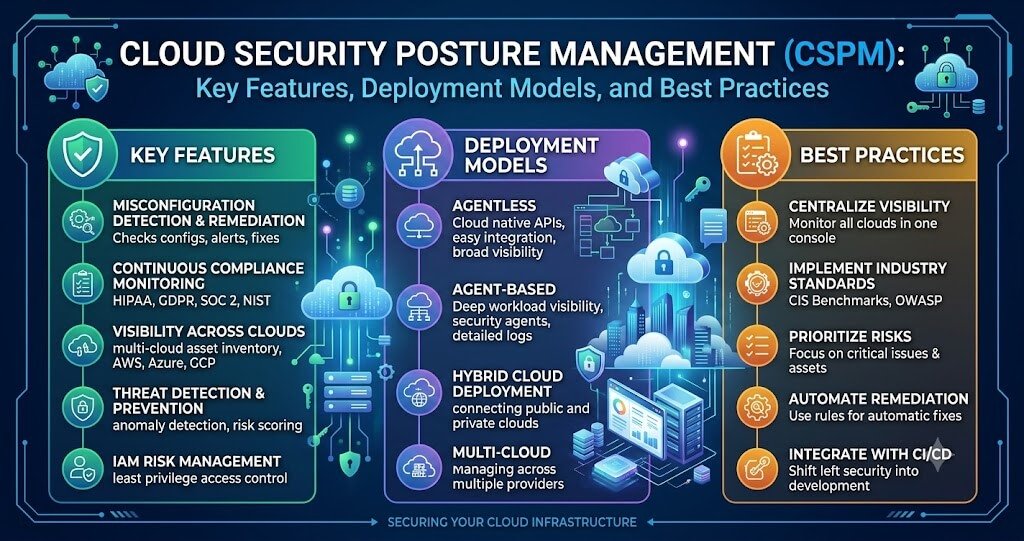
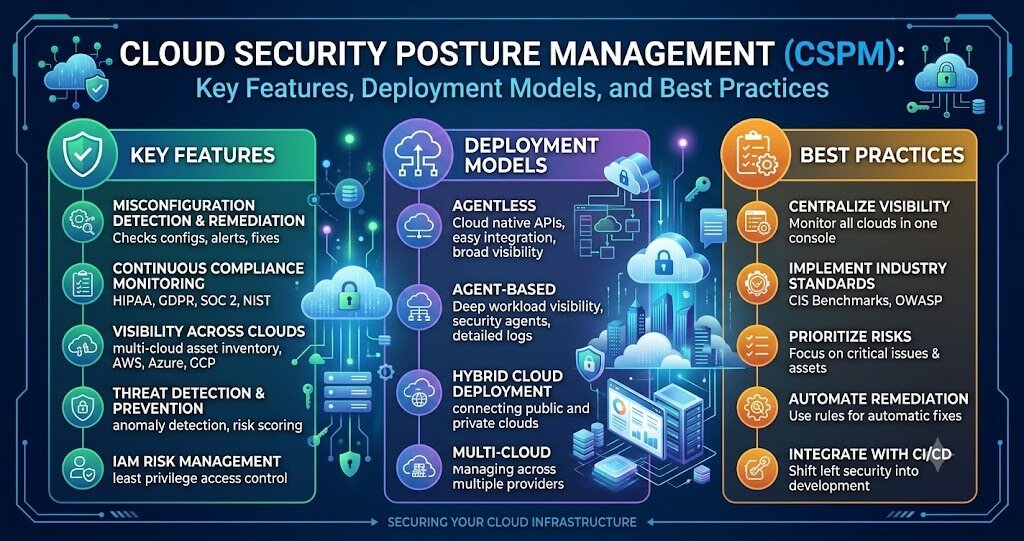
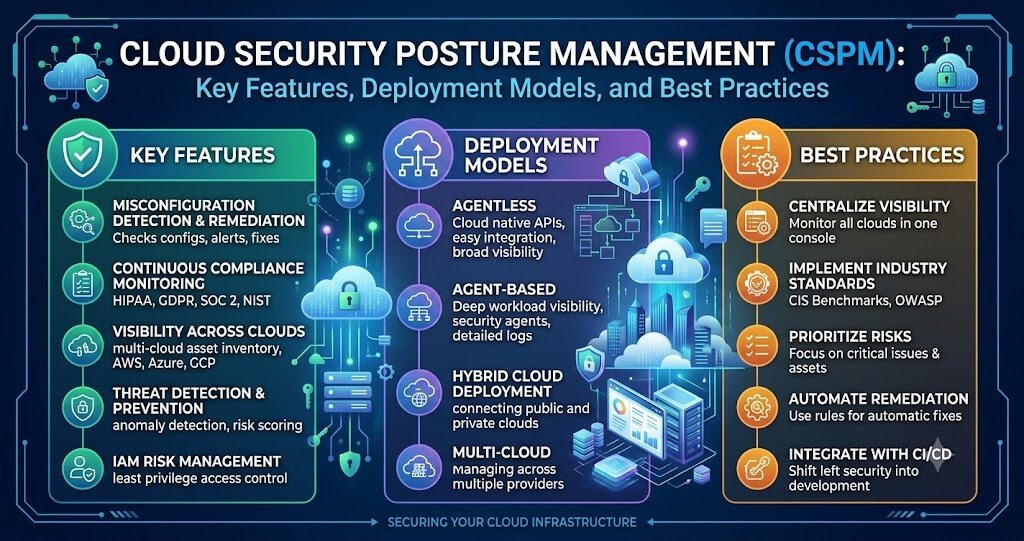
- Continuous asset inventory. Automatically discovering all resources across connected cloud accounts and regions, including resources created outside of sanctioned processes.
- Configuration assessment against benchmarks. Comparing resource configurations against established standards such as the CIS Benchmarks for AWS, Azure, and GCP, as well as frameworks like NIST and cloud-provider-specific well-architected guidance.
- Compliance mapping. Translating technical findings into mapped compliance status for frameworks such as PCI DSS, HIPAA, SOC 2, and ISO 27001, which is particularly valuable for organizations undergoing regular audits.
- Risk prioritization. Contextualizing findings based on factors such as public exposure, sensitivity of data involved, and whether the misconfigured resource is reachable from the internet, rather than presenting a flat list of every deviation from best practice.
- Remediation guidance and automation. Providing step-by-step remediation instructions, and in more mature platforms, automated or one-click remediation actions, or auto-generated pull requests against the infrastructure-as-code source of truth.
Agentless vs. Agent-Based Assessment
Most CSPM platforms operate in an agentless model, connecting to cloud provider APIs using read-only permissions to continuously pull configuration metadata without requiring any software to be installed inside workloads. This makes deployment fast and comprehensive, since coverage is not limited by which resources happen to have an agent installed. Some platforms supplement this with lightweight, agentless workload scanning — inspecting virtual machine and container images for vulnerabilities and secrets without a persistent in-guest agent — blurring the line between CSPM and Cloud Workload Protection Platform (CWPP) capability.
Shift-Left: Integrating with Infrastructure-as-Code
Because a significant share of cloud misconfiguration originates in Terraform, CloudFormation, or other infrastructure-as-code templates before resources are ever deployed, leading CSPM platforms extend their configuration checks into the CI/CD pipeline itself. Scanning IaC templates during the pull-request or build stage allows misconfigurations to be caught and fixed before provisioning, rather than being detected and remediated after the resource is already live and potentially exposed. This “shift-left” capability is increasingly considered a core CSPM feature rather than an optional add-on, since it materially reduces the volume of findings that reach production in the first place.
CSPM in the Broader Cloud Security Landscape
CSPM is one component of what is increasingly marketed as a Cloud-Native Application Protection Platform (CNAPP), a converged category that combines several previously separate tools:
- CSPM — configuration and compliance posture across cloud accounts.
- CWPP (Cloud Workload Protection Platform) — runtime protection and vulnerability scanning for virtual machines, containers, and serverless functions.
- CIEM (Cloud Infrastructure Entitlement Management) — analysis of IAM permissions to identify excessive or unused entitlements across cloud identities.
- IaC scanning — the shift-left capability described above.
Major cloud security vendors have moved toward offering these capabilities as an integrated platform rather than separate point products, reflecting the reality that configuration risk, workload vulnerability, and identity risk are deeply interrelated in cloud environments and are most effectively assessed together with shared context.
Evaluation Criteria for CSPM Vendors
- Multi-cloud support matching the organization’s actual provider footprint, including depth of coverage for less common services, not just the major compute and storage services.
- Benchmark and compliance framework coverage relevant to the organization’s regulatory obligations.
- Risk prioritization quality, specifically whether findings are contextualized by exposure and data sensitivity or presented as an undifferentiated list.
- IaC and CI/CD integration for shift-left scanning within existing development workflows.
- Auto-remediation capability and the granularity of control over which actions can be automated versus require manual approval.
- Breadth toward CNAPP, including CIEM and workload protection, if the organization wants to consolidate cloud security tooling rather than run multiple point products.
- Alert fidelity and integration with SIEM/ticketing, to ensure findings reach the teams responsible for remediation.
Implementation Best Practices
- Start with visibility before enforcement. Run the platform in assessment-only mode initially to build an accurate picture of existing posture before enabling automated remediation that could disrupt production workloads.
- Assign clear remediation ownership. Route findings to the specific development or platform team responsible for the affected resource, rather than centralizing all remediation in the security team, which rarely has the context or access to fix issues efficiently at cloud scale.
- Tier findings by exposure and severity so remediation SLAs reflect actual risk, prioritizing internet-facing and high-sensitivity findings first.
- Integrate posture checks into CI/CD to prevent recurrence rather than only remediating after deployment.
Common Pitfalls
- Alert overload from unprioritized findings, particularly during initial onboarding when years of accumulated misconfiguration surface at once.
- Enabling auto-remediation too early, before findings have been validated, risking disruption to legitimate production configurations.
- Treating CSPM as a security-team-only tool rather than integrating findings into development team workflows where the actual fixes need to happen.
- Incomplete cloud account coverage, particularly in organizations with decentralized cloud account creation where new accounts are not automatically onboarded to the CSPM platform.
Frequently Asked Questions
Is CSPM the same as a cloud firewall or WAF?
No. CSPM assesses configuration and compliance posture across cloud resources; it does not inspect or filter live network traffic the way a firewall or web application firewall does. The two are complementary rather than overlapping controls.
Does CSPM require installing agents in cloud workloads?
Core CSPM functionality is typically agentless, relying on read-only API access to cloud provider configuration data. Some platforms offer optional agent-based or agentless workload scanning for deeper vulnerability visibility, but this is generally an additional capability rather than a requirement for core posture assessment.
How is CSPM different from CNAPP?
CSPM refers specifically to configuration and compliance posture assessment. CNAPP is a broader platform category that combines CSPM with workload protection, identity entitlement management, and IaC scanning into a single integrated product, reflecting the industry’s move toward consolidated cloud security platforms.
Can CSPM findings be automatically fixed?
Many platforms support automated or semi-automated remediation for certain finding types, such as closing an unintentionally public storage bucket, though most organizations start with assessment-only mode and enable automation selectively for well-understood, low-risk finding categories.
Conclusion
Cloud misconfiguration remains one of the most consistent and preventable sources of cloud security incidents, precisely because cloud environments change faster than manual review processes can keep pace with. CSPM software addresses this by making configuration assessment continuous rather than periodic, and the strongest platforms extend that assessment upstream into the development pipeline through IaC scanning, reducing risk before resources are ever deployed rather than only after the fact.






Leave a Reply