

Introduction
Every piece of software an organization runs — operating systems, applications, network devices, cloud services, containers — periodically develops known security weaknesses that are publicly disclosed and, in many cases, actively exploited by attackers within days of disclosure. Vulnerability management software exists to make this problem tractable: to continuously discover what is running in an environment, identify which known vulnerabilities affect it, determine which of those vulnerabilities pose genuine risk given the organization’s specific context, and drive remediation before attackers can exploit them. This guide covers how vulnerability management software works, how modern risk-based prioritization differs from raw severity scoring, and what to look for when evaluating a platform.
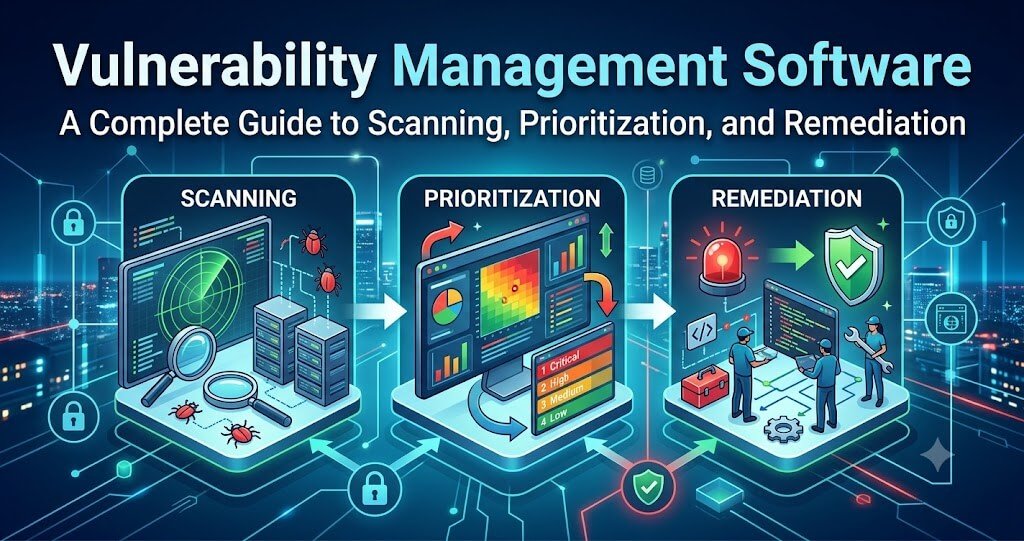
The Vulnerability Management Lifecycle
Vulnerability management is a continuous cycle, not a one-time scan:
- Asset discovery. Identifying every device, application, and cloud resource in the environment, including unmanaged and shadow IT assets that are frequently the source of unpatched exposure.
- Assessment. Scanning discovered assets to identify known vulnerabilities, typically matched against the Common Vulnerabilities and Exposures (CVE) database and vendor-specific advisories.
- Prioritization. Ranking identified vulnerabilities by actual risk, combining severity, exploitability, and asset criticality rather than treating every “critical” CVE as equally urgent.
- Remediation. Applying patches, configuration changes, or compensating controls, typically coordinated with IT operations teams responsible for patch deployment.
- Verification. Re-scanning to confirm that remediation was successful and the vulnerability no longer exists in an exploitable state.
- Reporting. Documenting the program’s performance for internal stakeholders and, where applicable, for compliance frameworks that require evidence of vulnerability management practices.
Scanning Methods
| Method | How It Works | Strengths / Limitations |
|---|---|---|
| Unauthenticated network scanning | Probes services from outside without credentials | Fast and broad, but limited visibility into OS-level and application-level vulnerabilities |
| Authenticated (credentialed) scanning | Logs into the target system to inspect installed software and configuration directly | Far more accurate and comprehensive; requires credential management |
| Agent-based scanning | A lightweight agent on the endpoint continuously reports installed software and patch status | Provides near-real-time visibility, including for remote/roaming devices not always on the corporate network |
| Cloud and container scanning | API-based assessment of cloud configurations, container images, and infrastructure-as-code | Extends coverage to modern cloud-native and DevOps environments where traditional network scanning is ineffective |
From CVSS to Risk-Based Prioritization
The Common Vulnerability Scoring System (CVSS) provides a standardized severity score for a vulnerability based on factors such as attack complexity and potential impact. However, CVSS alone is a poor prioritization mechanism at scale: large enterprises routinely have thousands of “critical” or “high” CVSS-rated vulnerabilities at any given time, far more than remediation teams can address immediately. Modern vulnerability management platforms address this by layering additional context onto raw CVSS scores:
- Exploit Prediction Scoring System (EPSS), which estimates the probability that a given vulnerability will actually be exploited in the wild in the near term, based on observed exploitation patterns.
- Known exploited vulnerability data, such as government-maintained catalogs of confirmed active exploitation, often warranting immediate remediation regardless of CVSS score.
- Asset criticality and exposure. A critical vulnerability on an internal, isolated development server generally poses less immediate risk than a moderate vulnerability on an internet-facing production system handling sensitive data.
- Compensating controls. Whether other security layers, such as network segmentation or EDR, reduce the practical exploitability of a given vulnerability in the specific environment.
This combined approach, generally referred to as risk-based vulnerability management (RBVM), allows security teams to focus limited remediation capacity on the small subset of vulnerabilities that represent genuine, near-term risk rather than attempting to patch every finding with equal urgency.
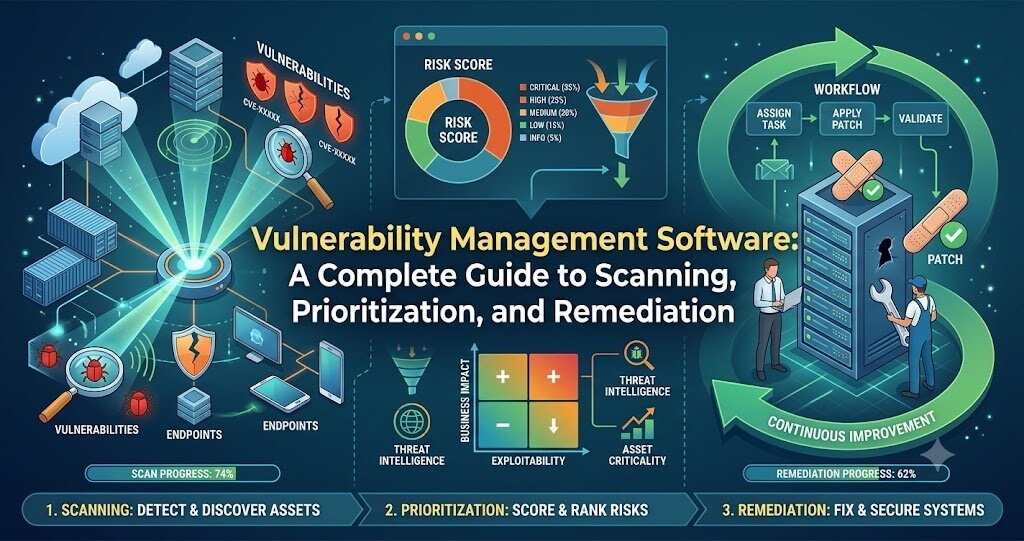
Integration with Patch Management and Remediation Workflows
Identifying vulnerabilities is only useful if it drives actual remediation. Mature vulnerability management programs integrate scanning output with:
- Patch management systems, allowing prioritized vulnerabilities to be mapped directly to available vendor patches and deployed through existing patch orchestration tools.
- IT service management / ticketing platforms, automatically opening tracked remediation tickets assigned to the appropriate asset owner with defined SLAs based on risk tier.
- Configuration management databases (CMDBs), ensuring vulnerability findings are mapped to accurate asset ownership and business context rather than generic hostnames.
Relationship to Attack Surface Management and Penetration Testing
Vulnerability management is closely related to, but distinct from, two adjacent disciplines. Attack surface management (ASM) focuses specifically on continuously discovering internet-facing assets — including forgotten or unauthorized ones — from an outside-in, attacker’s-eye perspective, which complements the typically inside-out approach of traditional vulnerability scanning. Penetration testing, meanwhile, involves human testers actively attempting to exploit vulnerabilities and chain them together to demonstrate real business impact, providing validation that automated scanning alone cannot. A mature security program uses all three in combination rather than treating any single one as sufficient.
Evaluation Criteria for Vulnerability Management Software
- Coverage breadth across on-premises infrastructure, cloud environments, containers, web applications, and OT/IoT devices where relevant to the organization.
- Scan accuracy, including false positive and false negative rates, which directly affect analyst trust and remediation team workload.
- Prioritization intelligence, specifically whether the platform incorporates EPSS, known-exploited data, and asset context rather than relying on raw CVSS alone.
- Scan performance and scheduling flexibility, balancing thoroughness against network and system performance impact.
- Remediation workflow integration with existing ITSM and patch management tooling.
- Compliance reporting mapped to relevant frameworks such as PCI DSS, ISO 27001, or NIST.
Common Pitfalls
- Scanning without a remediation process, generating large volumes of findings that are never actually resolved.
- Relying solely on CVSS severity, resulting in remediation teams chasing low-risk findings while genuinely exploited vulnerabilities remain open.
- Incomplete asset inventory, leaving unmanaged or shadow IT systems entirely outside the scanning scope.
- Credential scope gaps in authenticated scanning, producing incomplete results that understate actual exposure.
Frequently Asked Questions
How often should vulnerability scans run?
Most mature programs run authenticated scans at least weekly for critical assets, with continuous or near-continuous agent-based monitoring for internet-facing and high-value systems, supplemented by scans triggered immediately after major changes or new critical vulnerability disclosures.
What is the difference between vulnerability scanning and penetration testing?
Vulnerability scanning is largely automated and identifies known weaknesses at scale on a recurring basis. Penetration testing is a point-in-time, human-driven exercise that attempts to actively exploit vulnerabilities and chain them together, validating real-world impact in ways automated scanning cannot.
What does risk-based vulnerability management mean in practice?
It means prioritizing remediation based on a combination of severity, real-world exploitation likelihood, and asset business context, rather than treating every critical-rated finding as equally urgent, which is essential given that most organizations cannot realistically remediate every finding immediately.
Is agent-based or network-based scanning better?
They serve complementary purposes. Agent-based scanning provides continuous, credential-free visibility, especially for remote and roaming devices, while network-based scanning is useful for assessing devices that cannot run an agent, such as network infrastructure and certain IoT devices. Most comprehensive programs use both.
Conclusion
Effective vulnerability management is less about running scans and more about building a disciplined, risk-based process that turns scan output into prioritized, tracked remediation. Organizations evaluating vulnerability management software should weight prioritization intelligence and remediation workflow integration as heavily as raw scanning coverage, since a platform that finds everything but drives nothing to closure provides limited actual risk reduction.






Leave a Reply