


Bethesda’s first new IP in over two decades arrives with enormous expectations attached, promising the studio’s signature open-world freedom translated into a full space-faring RPG. Starfield delivers on scale in a way few games can match, but that scale comes with real trade-offs.
A Thousand Planets, A Handful Worth Visiting
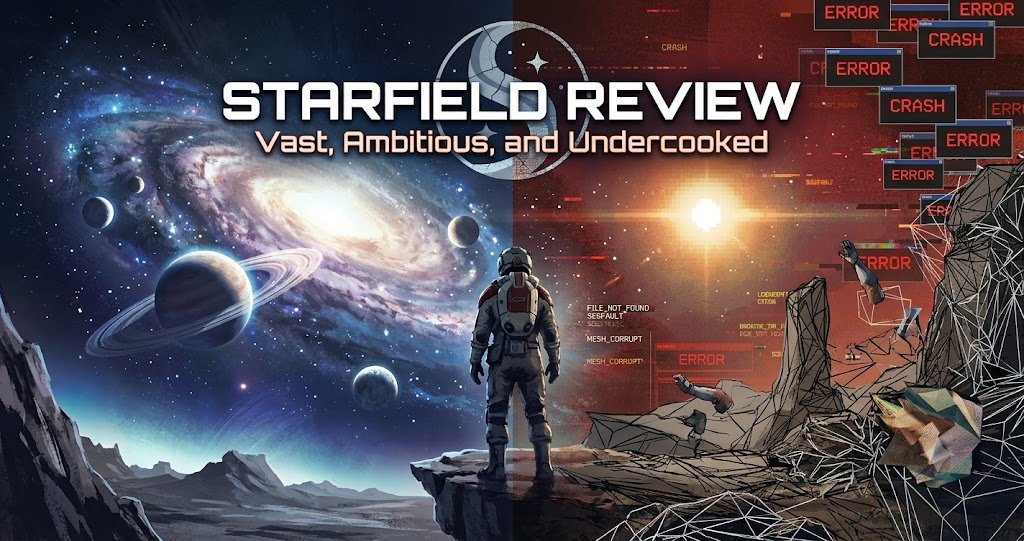
The headline feature—over a thousand explorable planets across dozens of star systems—is technically true and practically misleading. Most planets are procedurally generated expanses of rock, ice, or desert with sparse points of interest that repeat across the galaxy after a few dozen hours. The handcrafted content, when you find it, is genuinely excellent: cities like New Atlantis and Neon are dense with faction politics, side stories, and environmental detail. The imbalance between procedural filler and handcrafted highlights is the game’s central tension.

Ship Building Is the Real Star
Where Starfield shines brightest is its ship customization system. Players can design vessels piece by piece, balancing weapons, cargo, crew stations, and jump range, then take those custom ships into surprisingly tactical space combat. Outpost building offers a similar depth for players who enjoy base-building and resource chains. These systems reward the kind of patient, systems-driven players who loved Bethesda’s previous crafting mechanics in Fallout 4.
Factions and Writing
The main factions—the Freestar Collective, United Colonies, and the smuggler-aligned Crimson Fleet—offer distinct questlines with real moral shading, and the Crimson Fleet storyline in particular stands out for letting players go fully rogue. The main story, involving mysterious artifacts and an enigmatic group called the Starborn, is more mystical and philosophical than Bethesda’s usual fare, though it takes considerable time to build momentum.
Where It Stumbles
Loading screens between planets, cities, and even some building interiors break immersion constantly, undercutting the sense of a seamless universe. NPC animation and dialogue delivery haven’t meaningfully evolved from Bethesda’s older engine, which feels dated next to competitors’ character work. The much-touted exploration loop wears thin once players recognize the limited pool of procedural point-of-interest templates being recombined.
Verdict
Starfield is a game of genuine highlights buried in an ocean of empty space, both literally and figuratively. Its ship-building and faction writing are excellent, but the promise of a thousand planets ultimately proves more impressive as a number than as an experience.
Score: 7.8/10
- Pros: Deep, satisfying ship customization; strong faction questlines; handcrafted cities are excellent when you reach them
- Cons: Procedural planets feel repetitive and empty; constant loading screens break immersion; dated NPC animation and dialogue



Leave a Reply