

Introduction
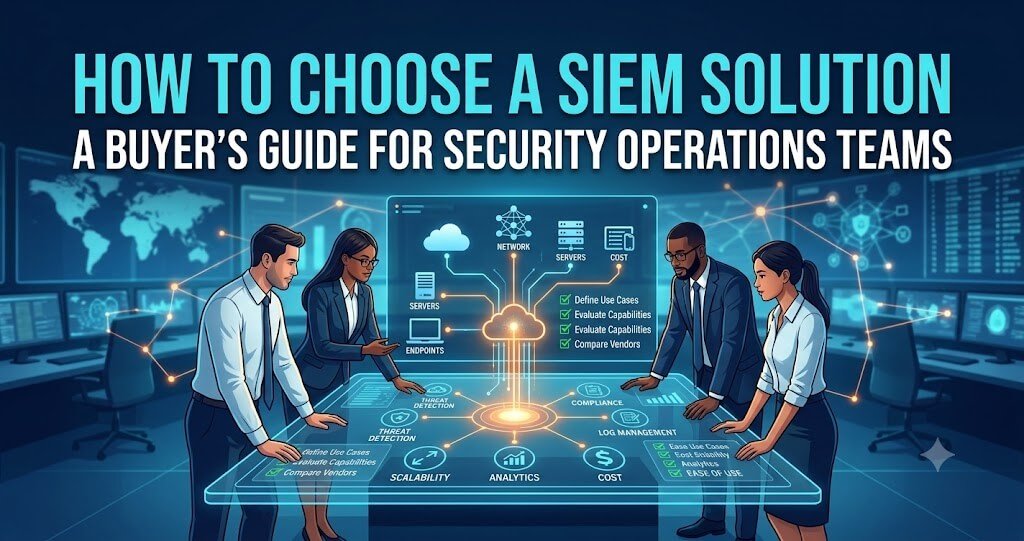
Security Information and Event Management (SIEM) software sits at the center of most security operations programs. It aggregates log and event data from across an organization’s infrastructure, correlates that data to surface potential threats, and provides the dashboards, alerting, and reporting that security analysts and compliance teams depend on. SIEM has also become one of the more consequential and expensive purchasing decisions a security team makes, both because of licensing cost and because a poorly chosen platform can leave a SOC drowning in noise rather than surfacing real threats. This guide walks through what SIEM software actually does, the architectural choices available today, and a structured framework for evaluating vendors.
Core Functions of a SIEM Platform
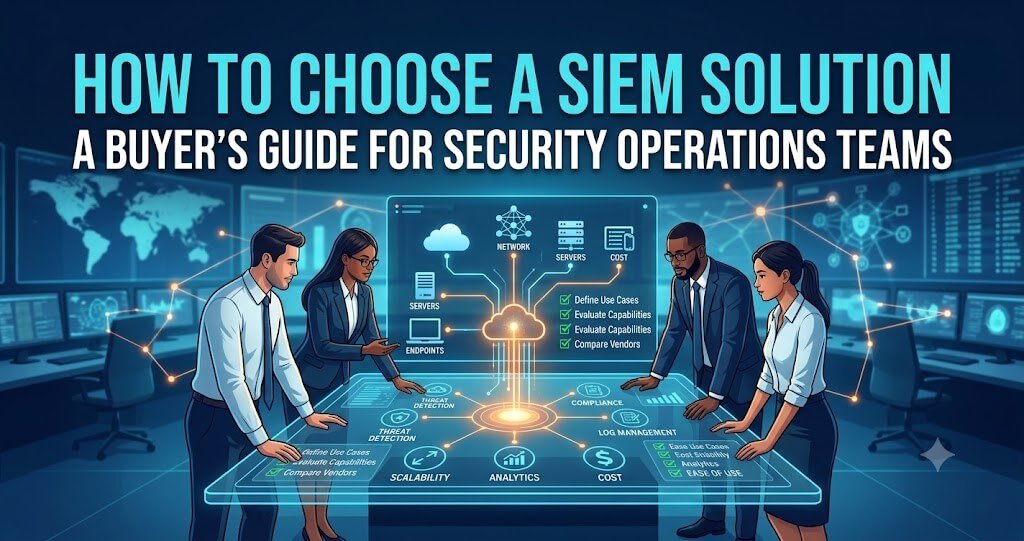
Despite significant differences between products, every SIEM performs some version of the following functions:
- Log collection and ingestion. Pulling structured and unstructured log data from firewalls, endpoints, servers, identity providers, cloud platforms, applications, and network devices, typically via agents, syslog, APIs, or cloud-native log export services.
- Normalization and parsing. Converting heterogeneous log formats into a common schema so that events from different systems — a failed login on a workstation, an identity provider, or a cloud platform, for example — can all be queried and correlated together.
- Correlation and detection. Applying rules, statistical baselines, or machine learning to identify combinations of events that indicate potential malicious activity, such as a login from an unusual location followed by mass file downloads.
- Alerting and case management. Surfacing high-confidence detections to analysts, often with built-in workflows for triage, escalation, and closure.
- Dashboards and reporting. Providing visibility for SOC operations as well as pre-built and custom reports for compliance frameworks such as PCI DSS, HIPAA, SOX, and ISO 27001.
- Long-term storage and search. Retaining log data for forensic investigation, threat hunting, and regulatory retention requirements, which can range from 90 days to several years depending on the framework.
Architectural Models: On-Premises, Cloud-Native, and Hybrid
Historically, SIEM platforms were installed on customer-managed infrastructure, giving organizations full control over data residency and retention at the cost of significant hardware, storage, and maintenance overhead. Most SIEM growth today is in cloud-native platforms — such as Microsoft Sentinel, built on Azure infrastructure, or Splunk Cloud — which shift storage, compute scaling, and platform maintenance to the vendor and typically bill based on data ingestion volume. Platforms built on the open-source Elastic Stack offer a third path, which can be self-hosted, run in a vendor-managed cloud, or deployed in a hybrid configuration. The right model depends on an organization’s existing cloud footprint, in-house infrastructure expertise, data residency requirements, and appetite for consumption-based billing versus predictable fixed licensing.
Detection Content: Where the Real Value Lives
A common mistake in SIEM evaluation is focusing entirely on ingestion and storage capability while underweighting detection content — the actual correlation rules, analytics, and threat intelligence that turn raw logs into meaningful alerts. Buyers should evaluate:
- Out-of-the-box detection rules mapped to the MITRE ATT&CK framework, so coverage gaps against specific tactics and techniques can be identified rather than assumed.
- User and Entity Behavior Analytics (UEBA), which builds behavioral baselines for users and devices and flags statistically anomalous activity, such as a service account suddenly authenticating from a new location or accessing systems it has never touched before.
- Threat intelligence integration, allowing the platform to automatically flag connections to known malicious IP addresses, domains, or file hashes.
- Custom rule authoring, including the query language’s expressiveness and the ease of tuning existing rules to reduce false positives for an organization’s specific environment.
SOAR Integration and Automation
Security Orchestration, Automation, and Response (SOAR) capability — either built into the SIEM or integrated via a separate product — allows repetitive triage and response actions to be automated: enriching an alert with threat intelligence, disabling a compromised account, or opening a ticket in the IT service management system without manual analyst effort. Given the volume of alerts most SIEM deployments generate, the availability and maturity of SOAR playbooks is often a decisive factor in whether a SOC can operate effectively at scale rather than being overwhelmed by manual triage.
Scalability and Total Cost of Ownership
SIEM pricing models vary substantially and materially affect total cost of ownership:
| Pricing Model | How It Works | Consideration |
|---|---|---|
| Ingestion-based | Priced per GB of data ingested per day | Costs scale with log volume; noisy log sources can drive unexpected cost spikes |
| Per-node / per-device | Priced per monitored asset or endpoint | More predictable, but may not account for data-heavy sources like firewalls |
| Per-user | Priced per analyst seat accessing the platform | Common in smaller deployments; does not directly reflect data volume |
| Consumption / compute-based | Priced on search and processing resources used | Requires active cost monitoring to avoid unpredictable bills |
Organizations should model expected daily log volume across all planned sources — including verbose sources such as firewalls, DNS, and cloud audit logs — before committing to a pricing model, and should ask vendors directly how retention beyond the included period is priced, since long-term storage is often where costs escalate.
Key Evaluation Criteria
- Breadth of supported log sources and the effort required to onboard new ones, particularly for the organization’s specific technology stack.
- Search performance at realistic data volumes, tested where possible with the organization’s own sample data during a proof of concept.
- Compliance reporting templates relevant to the organization’s regulatory obligations.
- Analyst experience, including query language learning curve, dashboard customization, and case management workflow.
- Integration ecosystem with existing EDR, identity, cloud, and ticketing tools.
- Vendor support and managed service options, particularly for organizations without 24/7 in-house SOC coverage.
Common Pitfalls
- Alert fatigue from insufficient tuning, where default rules generate high volumes of low-fidelity alerts that analysts learn to ignore, creating risk of missed genuine incidents.
- Underestimating onboarding effort for log sources beyond the small set covered by out-of-the-box connectors.
- Ingesting data without a clear detection use case, driving up cost without improving security outcomes.
- Neglecting log retention requirements tied to specific compliance frameworks until an audit reveals a gap.
Frequently Asked Questions
What is the difference between a SIEM and a log management tool?
Log management tools focus primarily on collecting, storing, and searching log data. A SIEM builds on that foundation with correlation, behavioral analytics, alerting, and case management specifically oriented toward security detection and compliance, rather than general-purpose log search.
Do small organizations need a SIEM?
Regulatory requirements, cyber insurance conditions, and the practical need for centralized visibility mean many small and mid-sized organizations do adopt SIEM, often through cloud-native platforms with consumption-based pricing or through a managed SOC provider that operates the SIEM on their behalf.
How long does a typical SIEM deployment take?
Initial deployment and onboarding of core log sources can take anywhere from a few weeks to several months depending on environment complexity, but tuning detection content to an acceptable signal-to-noise ratio is an ongoing process that typically continues well beyond initial go-live.
Can a SIEM replace EDR?
No. A SIEM correlates data from many sources including EDR, but it generally does not provide the deep endpoint telemetry, host isolation, or remediation actions native to an EDR agent. Most mature security programs run both, with EDR data feeding into the SIEM for broader correlation.
Conclusion
Choosing a SIEM is as much an operational decision as a technology decision. The platform with the most features is not necessarily the right fit if the organization lacks the staffing to tune detection content, manage ingestion costs, and respond to alerts. A disciplined evaluation — grounded in realistic log volume estimates, a proof of concept using representative data, and a clear-eyed assessment of in-house analyst capacity — will produce a better long-term outcome than selecting based on brand recognition or feature checklists alone.





Leave a Reply